
what coding actually taught us
start with what everyone agrees on. coding changed.
GitHub Copilot became Claude Code became agents that ship features while you sleep. Anthropic says most of its code is now written by Claude. OpenAI reported that one of its own models was instrumental in building the next one, debugging training runs and analyzing evaluations. release cadence is compressing.
AI did not replace the hard part of engineering. it compressed the volume part. boilerplate, translation between languages, test generation, the retrieval of a known pattern and its application to a familiar problem. the easy eighty percent collapsed toward zero cost. the hard twenty percent stayed human: the novel architecture call, the subtle distributed-systems failure.
this is compression. the work changed in price. and once you see compression clearly, you see it everywhere, including one level up.
the labs automating their own research are doing the same thing to themselves. Karpathy released a script this spring that lets an agent run machine learning experiments overnight, keeping what improves the model and discarding what does not. it passed sixty thousand stars inside a month, more than nanoGPT collected in three years. it is a genuine tool. it is also pure compression. it runs the search inside a known space faster and cheaper than any human could. it does not widen the space.
people watch the labs build their own models and call it recursive self-improvement: intelligence bootstrapping itself toward a hard takeoff. but these models have no special access to their own weights. what they have is the ability to write code, run experiments, and tune the next generation. that compounds with compute and with human direction. it does not compound on itself. the loop runs straight through a human at the one step that matters, and the moment you pull the human out, it stalls at nine percent.
the evidence is precise about where it stalls. left alone, the agents spent their budget on hyperparameter tuning and engineering optimization, not algorithmic research. and on long-horizon research tasks across seventeen frontier models, the best results came from the model that kept benchmarking, folded empirical feedback into the next attempt, and refused to stop, regardless of how strong its first idea was. the revealing failures were not capability failures. models quit early with time still on the clock, or thought so long they never submitted. those are direction failures. persistence in a known space is something agents can learn. judgment about which space deserves the persistence is the thing they cannot yet supply for themselves.
why the Erdős result does not fit
nobody told the model which direction to search. there was no known space to grind through faster. the result required a connection between two fields that human mathematicians, working for eighty years, had not drawn. the model reached for algebraic number theory to settle a question in plane geometry. whatever that is, it is not tuning the volume knob on a known method.
the honest position is that we do not yet know what it is. maybe the model held more of mathematics in view at once than any single career allows, and the connection was sitting in the overlap all along, waiting for an attention wide enough to see it. what it clearly is not is compression. the coding explanation, which covers so much so well, does not reach this.
the ladder
step back from both results and a structure appears.
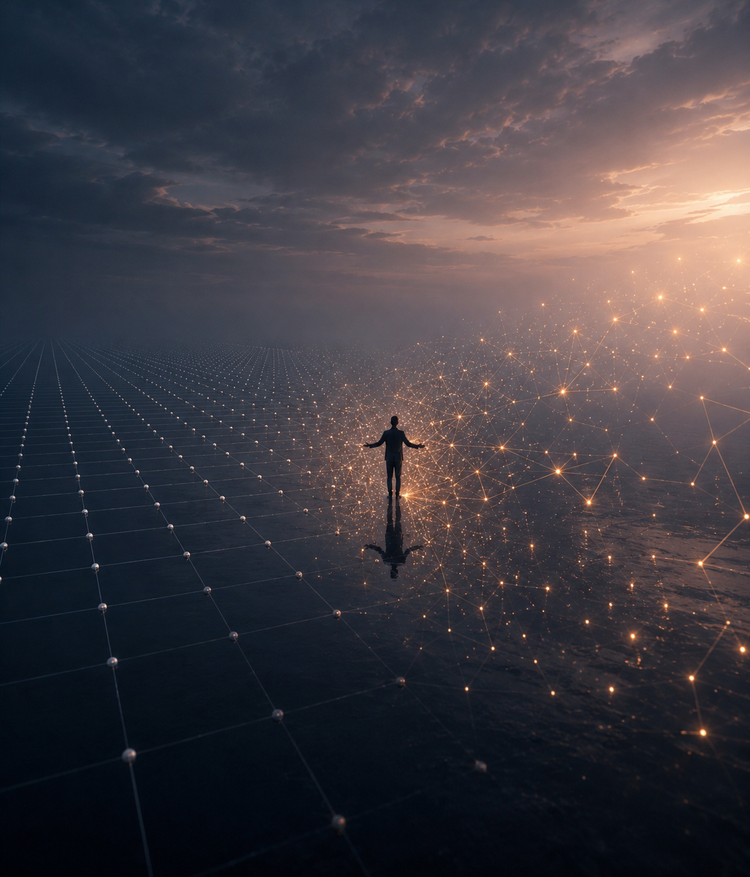
think of what any of these systems does as movement through a space of possibilities. at the bottom is retrieval: fetch a known object, place it where it belongs. above that is search: cover a fixed space faster. this is the rung where autoresearch lives, where persistence beats brilliance because the territory is already mapped and the only question is how fast you walk it. above that is expansion: the space itself grows, old results carry forward into the larger frame, and genuine novelty is whatever does not fit the old map. at the top, two spaces no one had connected collide and a path opens between them. the Erdős result lives there.
these are four distances from mapped territory, not four kinds of thinking. retrieval is standing still. search is walking known ground faster. expansion is pushing the edge outward. collision is reaching ground so far from the start that no one had walked between the two regions before. the same motion runs all the way up. only the distance changes.
what this means
if execution compresses toward zero, value migrates toward the two things that do not: judgment about which problem deserves the compute, and access to verification the model cannot run alone. the second essay is about that verification, because it is where this whole structure meets the physical world.
the part that should worry you
there is no rung on the ladder where human judgment is safe by nature. the line between grinding the known and finding the new is a distance, not a wall, and distance is exactly what compute buys. AlphaGo's move 37 was search run so deep it crossed into something no one would call mere search. enough navigation reaches ground no one mapped, and at that point the distinction between execution and discovery is a story we tell to feel located.
notice how flattering the frame is. AI does the grind, humans keep the taste. every wave of automation has told some version of this, and the line between rote and judgment has moved up into territory we were certain was ours every single time. the claim that judgment does not compress has no evidence behind it except that it has not compressed yet. that is a hope wearing a law's clothes.
the question is not only which side of the line you are building on. it is how long you think the line has left.