Eroom's Law is Moore's Law spelled backwards. deliberate.
every nine years, it costs twice as much to develop a new drug. this has held since 1950. through combinatorial chemistry in the nineties. through the genomics era. through high-throughput screening. through the first wave of AI drug discovery. every generation of scientists and investors believed their technology wave would break it. none did.
the pattern is so consistent it is a law of systems.
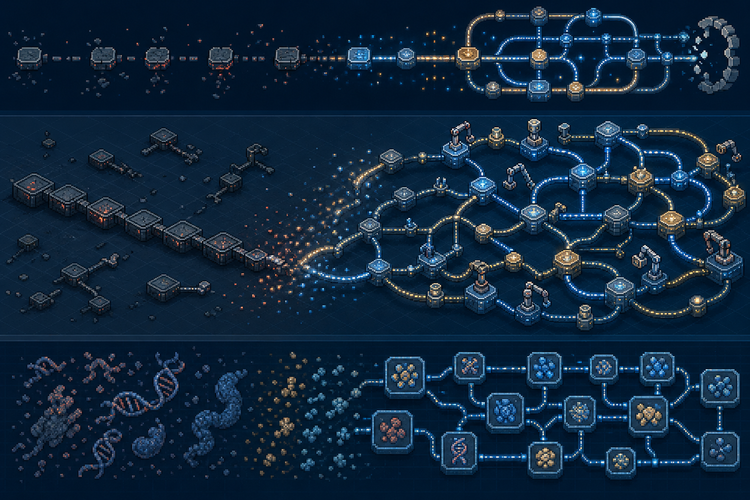
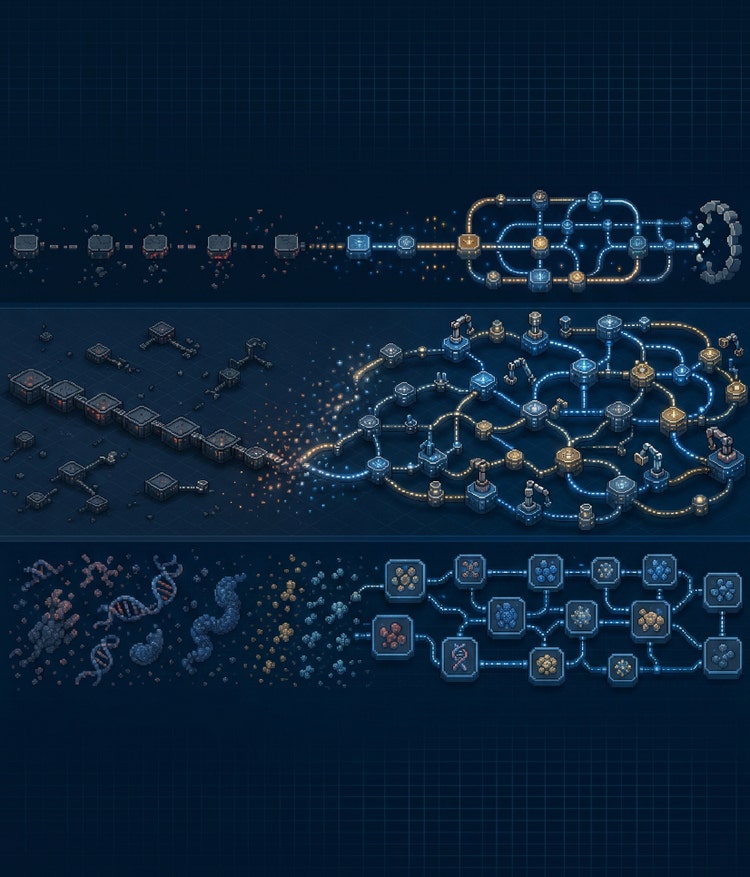
each previous wave failed for the same reason. it optimised one node inside a fixed, broken pipeline. better molecules fed into broken targets. better targets fed into a trial architecture designed in the 1960s. the pipeline ate the gains every time. you can double the speed of molecule generation and it does not matter if the target you are optimising against was wrong to begin with, validated in an animal model that does not reflect human disease, and destined to fail in a Phase 2 trial three years from now.
the real reason Eroom's Law held is not lack of innovation. it is that the diseases left unsolved are the ones where our models of human biology are known to be wrong. the easy diseases, where animal models predicted human outcomes, got solved. what remained were the hard ones. Alzheimer's. most cancers. psychiatric conditions. diseases where we have been pouring money into trials for decades, validating against biomarkers that do not predict clinical outcomes, using proxies for human disease that we know are inadequate.
AI was initially deployed on top of this broken foundation. faster molecule generation. better virtual screening. improved ADMET prediction. real capabilities. but aimed at the wrong layer of the problem.
so the skepticism is earned. the graveyard is real. and anyone telling you this time is different needs to explain specifically what is structurally different,here it is.
three things are changing simultaneously that have never changed together before.
the trial architecture itself is being redesigned.
the FDA announced continuous real-time trials, data transmitted directly from electronic health records to regulators, eliminating the hiatus between phases. eliminating the dead time between them. the EMA has issued its first-ever qualification opinion on an AI methodology in clinical trials. Sanofi is already using digital twins to reduce the number of patients needed in early clinical phases, building virtual patient populations from disease biology and pharmacology data to conduct faster first assessments of safety and efficacy before moving candidates into the clinic.
the sequential phase structure that consumed years between each checkpoint, and ate the efficiency gains of every previous technology wave, is no longer the only available architecture.
the human biology signal is finally legible at scale.
genome sequencing crossed $100, down from $100M in 25 years, faster than Moore's Law. AlphaGenome reads the 98% of the genome that AlphaFold never touched, the regulatory DNA that controls when and where genes switch on. and the one empirical finding that reliably predicts clinical success, almost never discussed in the AI for science narrative, is human genetic evidence. pursuing genetically validated targets increases the probability of clinical success by more than 2x. BridgeBio built their entire operating model on this single insight, and just reported three positive Phase 3 readouts in just over three months as the proof point.
the physical and digital loops are closing.
autonomous labs generating systematic perturbation data. models updating hypotheses. robots running the next experiment without a human in the loop. the feedback cycle that previously took months is compressing toward days. this matters not just for speed but for the type of data generated, causal intervention data, not just observation. what actually changes when you perturb the system. that is the data the next generation of biological models actually needs.
no previous wave changed all three simultaneously. combinatorial chemistry gave you more molecules but the same broken targets and the same slow trials. genomics gave you better target hypotheses but fed them into the same sequential clinical process. high-throughput screening gave you bench speed but left the pipeline intact. each wave was a better input into an unchanged system.
what is different now is that the system itself is being redesigned at multiple levels at once.
but one bottleneck remains that no previous analysis has correctly named.
what does it mean to approve a drug that was discovered, validated, and trialled by AI systems that were themselves learning throughout the process? the FDA published its first comprehensive AI framework for regulatory decision-making in January 2025, with final guidance expected in Q2 2026. the framework is arriving. but the legal and statistical theory for continuously learning trial systems, the audit trail, the credibility standards, the evidentiary standard for what counts as proof when the process generating the proof was adaptive, does not exist yet.
you can compress the science. you cannot yet compress the evidentiary standard.
every previous technology wave was absorbed by the pipeline. this wave is redesigning the pipeline. but the pipeline terminates in a regulatory decision. and the regulatory science for AI-native drug development is still being written.
whoever writes it does not just build a company. they set the terms for the entire industry.
that is wide open.